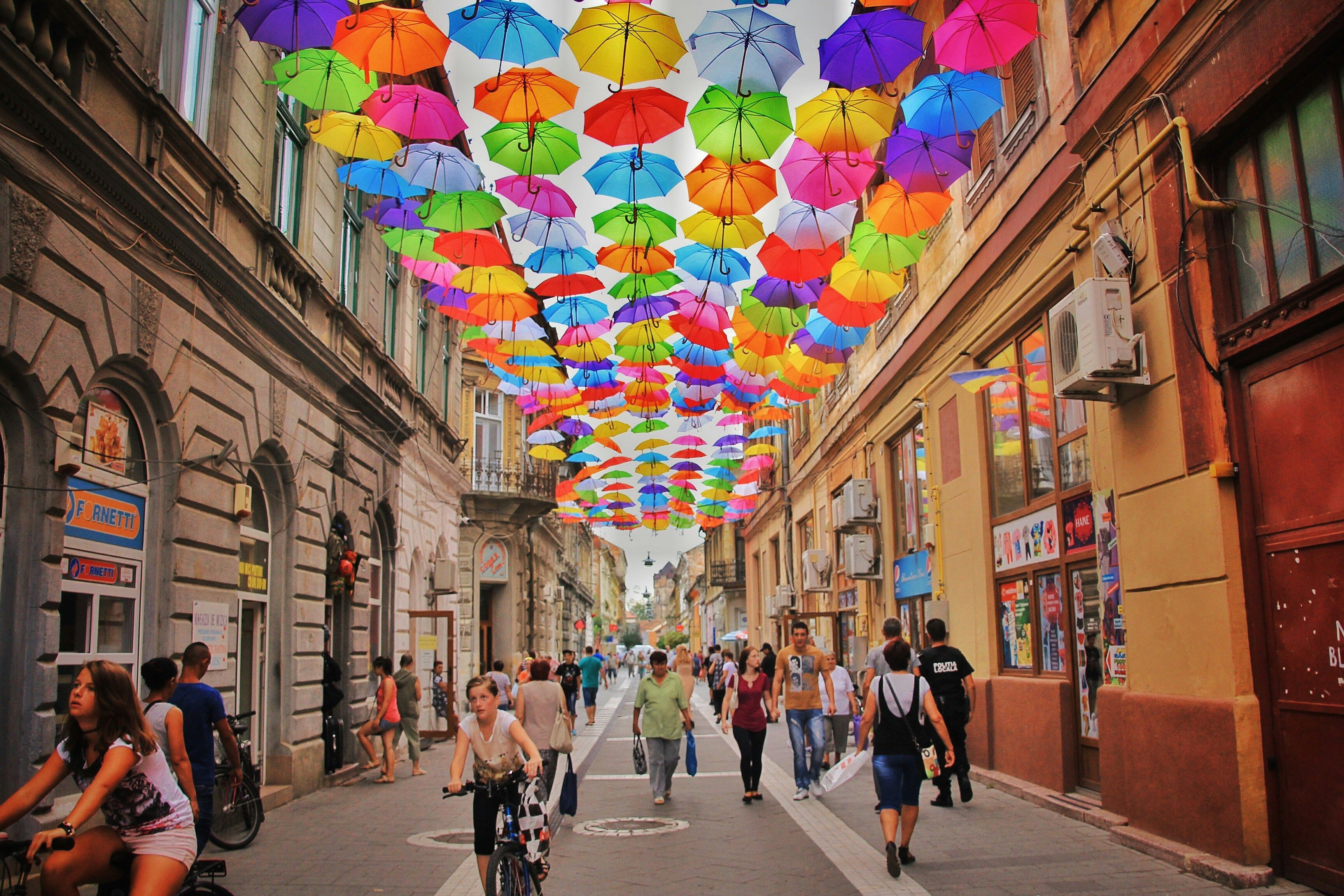
Sonder in Colour
Remembering that everyone is living in full saturation
There’s something strangely nice about seeing people just going about their lives.
A woman on the bus presses her forehead against the window, her tote bag folded in her lap. A boy in a red hoodie laughs into his phone. A young man crosses the street with flowers, walking hurriedly. Someone else walks carelessly, bumping into the umbrellas around them.
Sonder: the sudden awareness that everyone around us has a life as complex and vivid as our own. The word was created by John Koenig for The Dictionary of Obscure Sorrows, a project built around naming emotions that often go unnamed.
But sonder is not just a word.
We spend so much time caught up in our own lives that it’s easy to forget everyone else is doing the same thing. We have our own heartbreaks, errands, ambitions, insecurities, overdrafts, crushes, deadlines and family problems, and most of the time that is enough to keep us busy.
Then, you notice someone else properly: the person in the corner shop, the girl laughing on the phone with her friend, someone sitting alone on the bus. They are not just people you happen to pass.
They have somewhere to be, people they miss, things they are worried about, plans they might not have told anyone yet. Sonder is just that small reminder that everyone around you has a life that feels as full and important to them as yours does to you.
I felt this at my friend’s house party, when one of my friends suggested we go up to sit on the roof. I was deathly terrified of the height, but I joined them anyway because I’d had too much to drink and my decision-making was not exactly at its strongest.
The party was getting loud; everyone was doing a bit too much, and the roof just seemed like a good place to sit for a while. From up there, we could see the whole garden. People were scattered everywhere, drunk, laughing, and flirting. Everyone was wrapped up in their own little worlds.
And I think that is when sonder actually hit me; I realised that every single person at that party was experiencing the same night completely differently.
To me, it was just a random house party. To someone else, it was somewhere to go after dinner; to another, it was probably just a reason to get drunk with their friends.
We were all standing under the same lights, hearing the same music, drinking from the same plastic cups, but no one was having the same night.
Culture has always tried to preserve this feeling. Street photography does it with faces, Literature does it with words, Music does it with a lyric. Fashion does it too. Clothes are often the first language of sonder: colour, jewellery, shoes, a jacket borrowed from someone or a dress chosen for the sunny weather.
To see someone in colour is to admit they are not flat.
This is why people-watching feels so intimate. It is not gossip; it is a form of attention. The nineteenth-century idea of the flâneur, often described as an observer of modern urban life, treated the city as something to wander through and study.
But sonder makes that gaze a little warmer. You notice someone for a few seconds, wonder what they are talking about or where they are going, and then remember they could just as easily be doing the same thing to you.
The stranger on the train might also be wondering about you. Your chipped nail polish. Your headphones. The fact that you have opened the same message about six times without replying. You might only exist in their life for three stops, but for those three stops, they noticed you, too.
Projects like Humans of New York turned this feeling into a cultural practice. Brandon Stanton began it in 2010 as a photography project, stopping random people on the street to collect portraits and stories.
What began as an attempt to catalogue New Yorkers became something much more personal. It was a reminder that every stranger has something to say, and sometimes all it takes is one question to realise how much you would never have known about them.
And Sonder lives in those sentences.
It lives in the friend you only know at parties, but never in daylight. That auntie at the salon who knows everyone’s business but never tells her own. The cashier who says “have a nice day” while not having one herself.
It is in all the small things we usually don’t think twice about: a receipt tucked into a phone case, a voice note that was never sent, a father buying plantains after work, a twelve-year-old walking home from school. None of it seems important on its own, but once you start paying attention, even the most ordinary things begin to feel worth noticing.
This is what “in colour” means. Not brightness or prettiness. Not aesthetic just for aesthetic’s sake.
It is colour as evidence of life: red for anger swallowed politely, green for envy dressed up as admiration, blue for the sadness people carry well, gold for the tiny moments of being loved correctly, pink for softness, black for privacy and white for the blank page everyone wakes up to.
Sonder in culture matters because it resists the flattening of people; in public they are obstacles and in memory they become extras. We do not have to know everyone we pass; that would be insanely impossible and exhausting, but it is worth remembering there is always more to them than the little bit we get to see.
Sonder is that brief moment when you stop thinking only about your own life and remember that everyone around you has one too.
You will never know most of those people properly.
But for a brief second, you remember they are there.