They Burned Women, Not Witches
The witch was never real. The women were.
For centuries, Europe hunted a creature that did not exist. The night-flying, devil-consorting phantom stitched together from male fear.
Rewritten
Once upon a time, the word witch meant wise woman. Long before the Church reshaped the meaning, these women were central figures in their communities. In early medieval Europe, in Celtic regions and Germanic folk cultures, they acted as healers, midwives and keepers of inherited knowledge. They treated fevers with herbs, delivered babies, soothed grief, settled disputes and offered spiritual guidance. In many villages they were the closest thing to a modern doctor, counsellor, or therapist.
That was precisely why she became dangerous.
As Church authority expanded and became more and more dogmatic, male theologians grew increasingly anxious about women who held influence outside of clerical control. A woman who could heal without a priest, who understood the rhythms of the body, who spoke confidently or lived independently, threatened the hierarchy the Church was building. When crops failed, a child fell ill, or disaster struck, these women’s precarious circumstances made them perfect scapegoats for a misogynistic and superstitious medieval society.
Around 78 per cent of those accused of witchcraft were women. This was not accidental. Widows, unmarried women, childless women and women who lived alone were especially vulnerable because they lacked male guardianship.
Men were accused too, but usually for different reasons. They were targeted when they were related to accused women, when they practised folk healing, when they were political inconveniences, or when they were outsiders in their communities. Their persecution was real, but the witch hunts overwhelmingly focused on women because misogyny shaped the very definition of the crime.
And so the wise woman was rewritten into the witch by men who feared what they could not command.
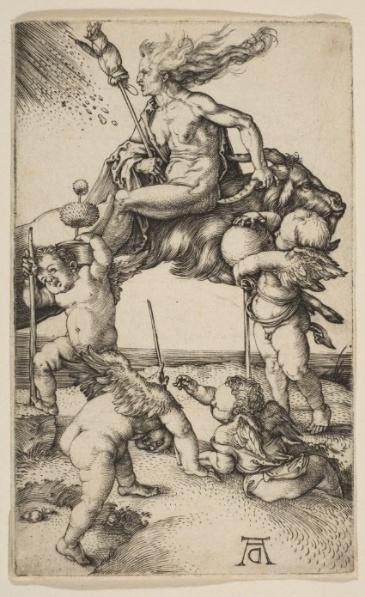 Albrecht Dürer, Witch Riding on a Goat, c. 1500. British Museum, London.
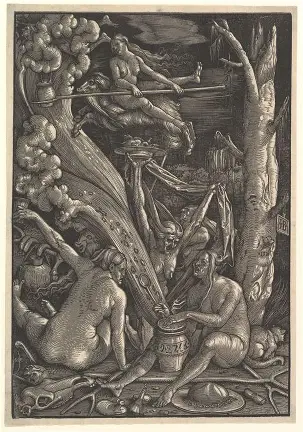 Hans Baldung Grien, The Witches’ Sabbath, 1510. The Metropolitan Museum of Art, New York.
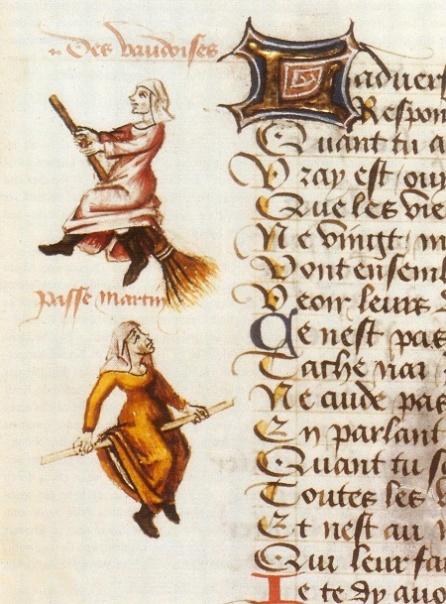 Martin Le France, Le Champion des Dames, 1451. Wikimedia Commons (public domain).
How Art Built the Witch
Medieval art played a major role in turning witches into a recognisable enemy. In the early 1500s, Albrecht Dürer painted Witch Riding on a Goat: a naked woman hurtling through the air on a goat, a creature associated with lust and the devil. Hans Baldung Grien's woodcut The Witches’ Sabbath (1510) shows a group of women gathered around a cauldron, surrounded by smoke, animal skulls and curling flames; the witches are naked, wild-haired and physically powerful. Baldung’s images had bias; they portrayed female bodies as chaotic forces of nature, capable of raising storms and summoning spirits, and helped cement the idea that female sexuality itself was dangerous.
Manuscripts also shaped the myth: Martin Le France’s Le Champion des Dames, from 1440, depicted women flying on broomsticks, a visual that would later become one of the most enduring and iconic symbols of witchcraft. These images circulated widely, copied by scribes, reinterpreted by artists and absorbed into folklore. By the sixteenth century, the flying witch appeared in woodcuts, pamphlets, morality plays and travelling theatre, where she was used to frighten audiences and warn them about female disobedience. The witch therefore became a stock character in modern storytelling.
The broomstick eventually appeared in modern popular culture, appearing everywhere from books such as Room on the Broom, Harry Potter, and The Wonderful Wizard of Oz to films like Stardust, Hocus Pocus, and Kiki’s Delivery Service.
In reality, the broomstick wasn’t chosen at random. Its phallic symbolism comes from medieval medical and theological writings that associated women’s bodies with disorder and temptation. Some demonological texts claimed witches used household objects to apply flying ointments made from hallucinogenic herbs, which created the image of women straddling sticks or poles. Artists exaggerated this into a sexualised symbol, turning an everyday domestic tool into a visual metaphor for female transgression. These images were propaganda disguised as documentation and taught Europe what a witch should look like long before any trial began.
The typical perpetrator: Misogyny
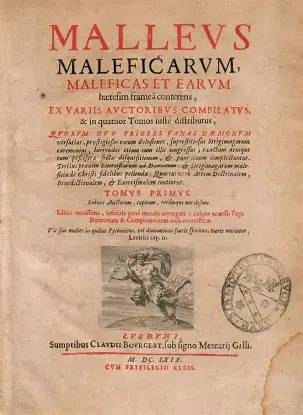
By the late 15th century, the Church had reframed witchcraft as a form of Satanism. Pope Innocent VIII’s 1484 bull declared witchcraft a diabolic crisis. Two years later, Heinrich Kramer published the Malleus Maleficarum, a text that reads less like theology and more like a manifesto of misogyny, describing women as “malicious, feeble-minded, greedy, and jealous”; claiming their “insatiable carnal lust” made them easy prey for the devil. Kramer's writing paved the way for men fearing women’s desires and permitted Europe to treat ordinary women as a threat.
This fear did not stay within the Church. It moved into the courts and then into the hands of men who made witch hunting their profession. Demonologists insisted that women attended nocturnal gatherings where they kissed the devil, renounced Christianity, mixed poisons, raised storms and performed sexual rituals intended to bind them to demonic power. One of the most notorious was Matthew Hopkins, the self-appointed Witchfinder General who operated in England during the 1640s. Hopkins travelled from town to town offering his services to local magistrates. He claimed to identify witches by searching for “devil’s marks”, often nothing more than moles or scars. He used sleep deprivation, forced walking, and relentless interrogation to extract confessions. His methods were brutal, and his victims were almost always women who were poor, elderly, or socially isolated.
Hopkins was responsible for the execution of more than 100 people in just two years. His rise shows how misogyny could be weaponised not only by the Church but by ambitious men who saw witch hunting as a path to power, money and influence.
The Salem Witch Trials
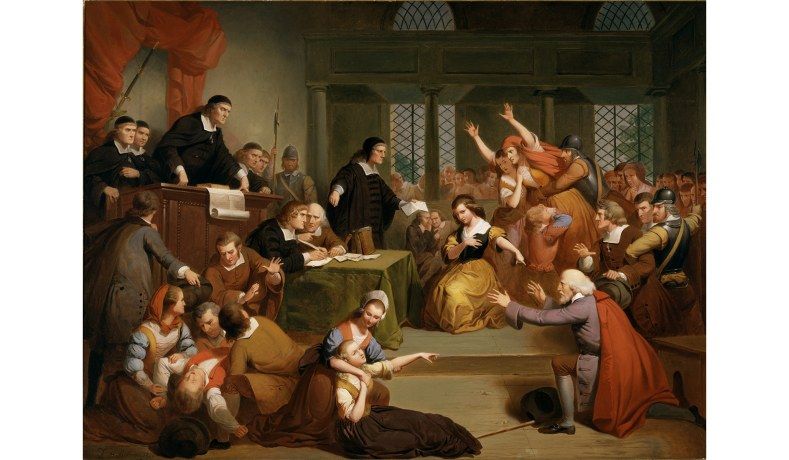
Between 1400 and 1775, around 100,000 people were prosecuted for witchcraft in Europe and British America, and 40,000 to 60,000 were executed, most of them women. By the time the Salem witch trials began in 1692, the pattern therefore was already established.
Original trial records show interrogations built on coercion. People were questioned for hours, kept awake, pushed to contradict themselves and told that any pain or confusion was proof of guilt. Suffering was treated as “a judgment upon sin”, which made every grimace, every tremor, every tear into supposed evidence.
In Salem, the methods were simple and brutal. Prisoners were kept in freezing, overcrowded cells. They were chained to walls, denied sleep and forced to pay for their own food. Under those conditions, confession became a way to stop the immediate misery.
Some cases show how far the authorities were willing to go. Giles Corey, a 70‑year‑old farmer, refused to plead, so they crushed him slowly under stones, waiting for him to break. He didn’t. His chest collapsed before he spoke. Tituba, an enslaved woman in the home of Reverend Samuel Parris, was accused by the girls in the household and then beaten and threatened by Parris until she repeated the stories they wanted. None of these words were freely given. They were dragged out of people who were already in pain.
Now
Witch hunts did not end with the seventeenth century. They did not end with Salem. They did not end with the last execution in Europe. They simply moved. Today, accusations of witchcraft remain endemic in parts of sub‑Saharan Africa, India, Papua New Guinea, Amazonia and Indonesia. The United Nations Human Rights Council reported in 2023 that hundreds of thousands of vulnerable people are harmed every year because of belief in witchcraft. A 2020 UN report estimated that at least 20,000 people were killed across 60 countries between 2009 and 2019.
Attempts to repair the past continue. After the Salem trials, families spent decades petitioning for reversals of convictions and compensation. In 1711, the colony finally agreed. More recently, on International Women’s Day in 2022, Scotland’s ex‑First Minister Nicola Sturgeon issued a national apology to the thousands of people accused and executed for witchcraft between the 16th and 18th centuries. Her statement was part of a wider movement to exonerate victims and acknowledge the misogyny that shaped their persecution.
But while governments apologise for historic witch hunts, modern ones are growing. In many regions, fundamentalist religious groups still cite biblical passages such as “Thou shalt not suffer a witch to live” (Exodus 22:18). And the consequences are not confined to remote communities. In 2010, 15-year-old Kristy Bamu was tortured for days in London by relatives who believed he was a witch. On Christmas Day, he was forced into a bath for an exorcism and drowned. His death helped prompt the creation of the Amber Project in 2021, aimed at protecting children from witchcraft‑related abuse.
The witch is not a relic of medieval imagination or early modern theology. She is a modern scapegoat. The same forces that once turned women into symbols of disorder: fear, superstition, poverty, misogyny, and the need to blame someone, still operate today. The image created by centuries of art, demonology and trial records continues to shape who is believed, who is feared, and who is sacrificed.
The witch was a myth. The consequences are not.